
2026-07-01
Guide: Which reverse vending machine should you choose?
As Deposit Return Schemes (DRS) expand across Europe, grocery retailers face a major operational shift. Compliance is a legal mandate, but the type of hardware you choose dictates how seamlessly recycling integrates into your daily business.
Choosing the right system is a balancing act between three things: available square footage, expected container volume, and customer convenience.
Rather than looking for a one-size-fits-all machine, business owners should evaluate the three primary categories of reverse vending technology to see which architectural setup fits their specific environment.
1. Standalone systems: best for limited floor space
A standalone reverse vending machine is an all-in-one, self-contained unit. The container entry point, barcode scanners, compaction technology, and storage bins are completely enclosed within a single physical cabinet that sits directly on your retail floor or an external forecourt.
- The Setup: Plug-and-play. They typically operate on single-phase power, require less than 2 square meters of total floor space, and do not require any structural walls or renovations.
- When to choose this type: If you run a convenience store, an independent urban grocery shop, or a petrol forecourt with tight square footage and no dedicated backroom space adjacent to the shop floor.
- Real-world examples: For small-to-medium footprints, manufacturers design these units to maximize internal capacity within a tight outer shell. For instance, RVM Systems offers the X-Series standalone line. Within this category, a store looking only to collect PET and cans might look at a compact option like the RVM Systems X20, while a retailer in a region mandating glass collection (like Ireland or Wales) would utilize a multi-material standalone unit like the RVM Systems X30.
2. Modular systems: Best for hiding logistics behind the Wall
A modular system splits the machine’s architecture into two sections. The consumer only interacts with a sleek, flush-mounted user interface panel on the shop floor. The actual compaction machinery, conveyor belts, and large storage bins sit entirely behind that wall, hidden away in your backroom, stockroom, or warehouse.
- The setup: Tailored and expandable. The front panel cuts through a partition wall and connects to backend storage cabinets that can often be arranged or turned at angles to fit your specific backroom layout.
- When to choose this type: If you run a mid-to-large supermarket with an adjacent stockroom and want to keep the noise, sticky residue, and daily bin-emptying operations completely invisible to your shopping aisles.
- Real-world examples: This layout is highly customizable. In the modular space, RVM Systems Group builds the ProLine Modular Series. If a medium supermarket has high traffic but narrow backroom corridors, a narrow-profile option like the ProLine Slim is a common configuration. If a busy supermarket chain needs to accommodate two customers returning items at the exact same time, the setup can be expanded into a ProLine Duo, which links two front-facing user panels to a shared backend line of up to eight Euro-pallet-sized storage cabinets.
3. Multi-feed systems: best for high-volume, bulk processing
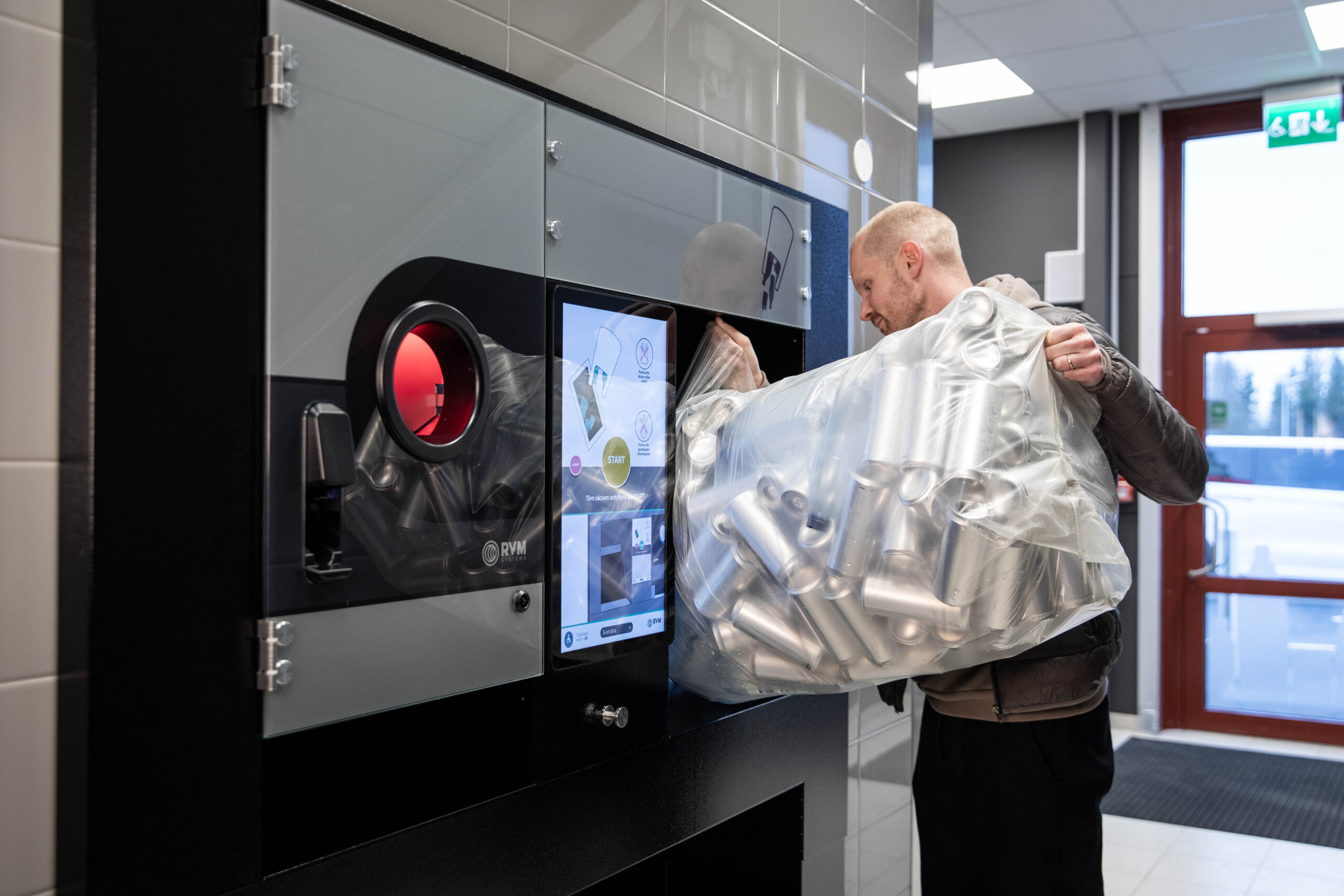
Multi-feed (or bulk-pour) systems represent the highest tier of customer convenience. Instead of forcing consumers to insert bottles and cans item-by-item, these machines feature a wide hopper where users can literally pour an entire bag of mixed recycling into the machine all at once.
- The setup: High-speed automation running on heavy-duty three-phase power, utilizing advanced sorting belts that rapidly separate, identify, and compact containers.
- When to choose this type: If you operate a high-volume hypermarket, a major retail park, or a dedicated redemption center where long weekend lines at traditional single-feed machines would cause customer frustration and turn shoppers away.
- Real-world examples: Because these machines process mass volumes, material handling is highly specific. For example, the RVM Systems Mega ProLine+ series is engineered to process mixed PET plastic, aluminium cans and glass at speeds up to 100 containers per minute.
